The best unified engagement platform for loan officers to close more deals
A unified engagement platform unifies all your customer chat, texts email, calls, and voicemail drops, social messages in one place. Small businesses leverage these tools to save time, record every lead, and respond to customers quicker.
Additionally, with automated workflows leveraging landing pages, emails, SMS and ringless voicemails minimize manual work and elevates outcomes, enabling loan officers to invest their time in building relationships and closing loans faster
For busy mortgage brokers and individual owners, that translates into less missed messages and more opportunities to establish trust. To illustrate how a unified engagement platform can align with your business, the following sections offers practical solutions for selecting and implementing.
Key Takeaways
A unified engagement platform consolidates all communication channels, allowing loan officers to handle customer interactions and marketing activities from one place.
Multi-channel centralized communication enhances campaign success, maintains brand voice consistency, and accelerates response times, for increased lead conversion and client retention.
Automated workflows leveraging landing pages, emails, SMS and ringless voicemails minimize manual work and elevates outcomes, enabling loan officers to invest their time in building relationships and closing loans faster.
For example, connected funnels steer borrowers seamlessly from inquiry to closing. Actionable analytics provide insight to optimize marketing and boost conversion.
With seamless integration to your existing mortgage software like ARIV, a CRM tool like NationwideLeads boosts data accuracy and streamlines processes
Using a scalable and easy-to-use CRM with excellent support and free onboarding gets loan officers ready for future while fueling productivity and growth.
Table of Contents
What is a unified engagement platform
The essential characteristics of a unified engagement platform
Why unification beats separation for loan officers
How to choose the right real estate loan CRM
The future of mortgage CRM software
What is a unified engagement platform?
What are the key features of a unified engagement platform?
Why should loan officers use a unified engagement platform?
How does unification improve loan officer performance?
What should you look for in a real estate loan CRM?
What is a unified engagement platform
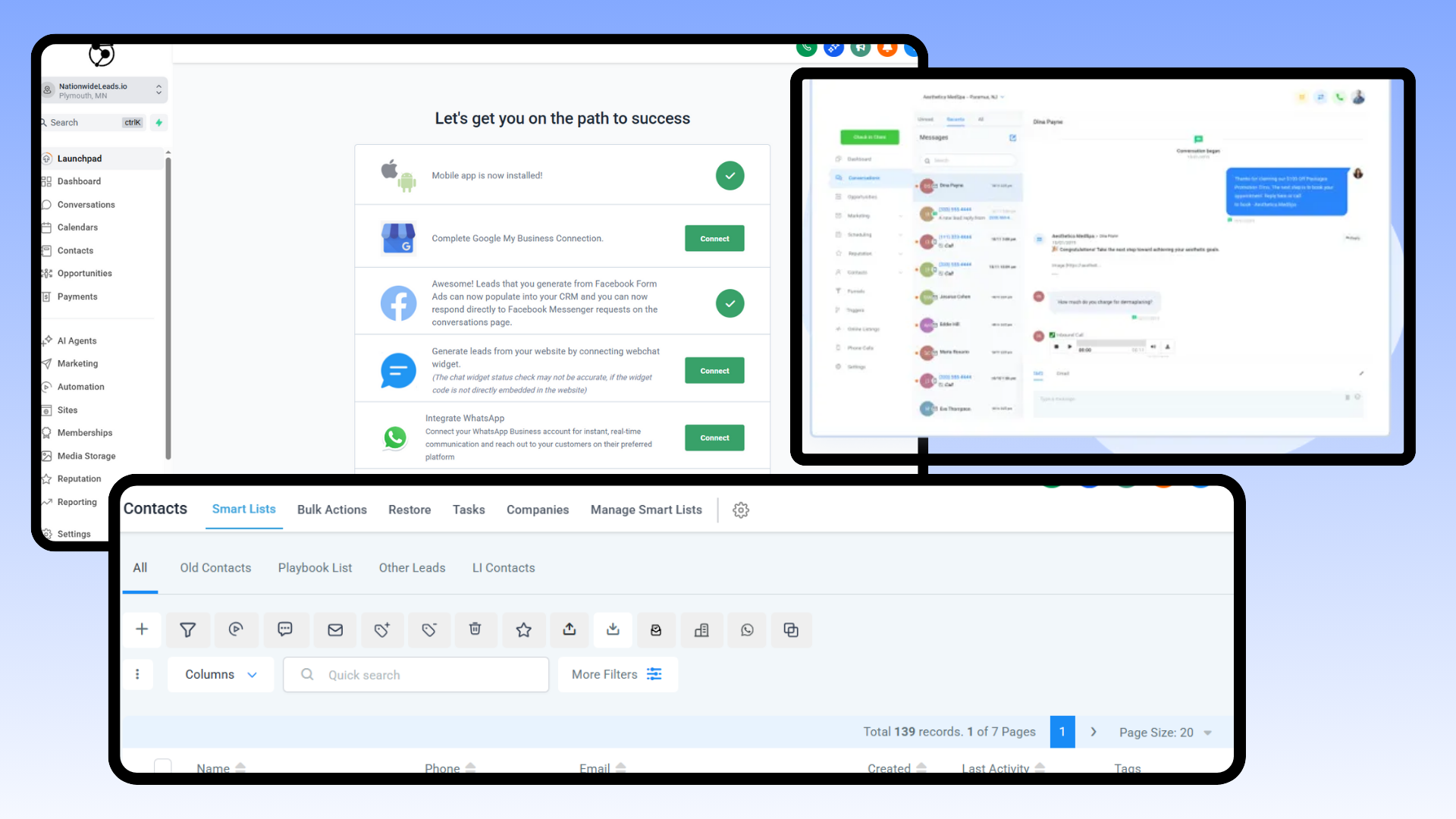
A unified engagement platform is software that consolidates all your communication channels, including email, SMS, web chat, ringless voicemails and more, into one location. For LO’s, this means you don’t have to hop from tool to tool to follow your client. Instead, you leverage a central hub to view every message, campaign, and response, with all that data aggregated for you.
This makes it significantly simpler to maintain coherent customer data, identify patterns, and respond quickly to what your clients desire or need. These platforms are designed to be more than simple inbox aggregators. They collect all customer data, including names, emails, phone numbers, click behavior, when they engage, and how they behave on your website.
This allows you to develop a complete 360-degree customer view. Now you can view not only what someone did last, but what they prefer and how they like to hear from you. For instance, if a borrower responds more effectively to text than email, you will know to communicate via SMS for fast updates or reminders.
Unified engagement platforms help you run analytics workflows straight from the platform. They consume information from multiple sources, including structured templates, unstructured conversation history, and even pictures or audio snippets. With it all in one place, you can more easily identify which marketing efforts are working.
Here’s one more point: these platforms have enterprise-grade data governance and privacy controls, so you can manage permissions and keep information safe. This is critical as your business scales and you want to scale up without concern that you’ll lose control of your data.
Run omnichannel marketing campaigns is a big plus. Set up automated email drips, ringless voicemail drops, fire off SMS alerts, or customize web content—all from a single dashboard. It maintains consistency in your messaging and supports lead nurturing through every point of their journey.
For loan officers, this counts when you desire immediate, personable follow-ups or when you have to monitor every client’s status throughout various channels. Having it all in one place eliminates siloed data. You can easily see who is primed for the next step, who needs a nudge, and which campaigns are generating traction.
This translates to increased engagement, quicker content distribution, and more effective team workflow.
Checklist: How a unified engagement platform simplifies the mortgage process
Unified engagement platform combines email, SMS, ringless voicemail, phone, web chat and social media DMs for easy follow-up.
Stores all customer info and interactions in one place.
Builds full profiles to tailor messages and timing.
Automates marketing and follow-up tasks.
Close leads faster from landing page to email and ringless voicemail drops
Makes it easy to track and analyze customer behavior.
Helps teams share updates and content faster.
Improves privacy and data security.
Scales as your business and client list grow.
The essential characteristics of a unified engagement platform

All your communication, data, and workflow tools are in one place with a unified engagement platform. For lending and services businesses, this configuration eliminates confusion, streamlines tasks, and promotes collaboration. Here are the key attributes of a unified engagement platform.
Automated data ingestion is standard, allowing businesses to collect information from emails, forms, calls, or even images and videos. It should be able to handle new channels or data types as they emerge, so the platform must support structured, unstructured, and semi-structured data.
Scalability matters since as a business grows, so does its data. Utilities such as Zapier assist in sharing data across LOS and CRM without replicating it, maintaining it precise and updated. Security and privacy controls comply with regulations and protect client information, while strong governance guarantees that only appropriate employees can access sensitive data.
These platforms should be industry agnostic and support rich customer profiles, which include things like purchasing behavior and preferred channels. By consolidating all data into a single hub, analytics become easier and quicker, aiding businesses in taking action on information immediately.
1. Centralized communication
Centralized communication pulls emails, chat logs, voice notes, and social media messages into one dashboard. This setup enables mortgage teams to view all client interactions, simplifying the process of tracking conversations and providing quicker responses.
When we’re all working from the same info, double-work and mixed messages disappear. A shared record lets teams notice patterns of questions or issues, so they can address problems before they escalate. Loan officers can utilize these to maintain their voice across every channel, whether it’s text, email, or phone, providing borrowers a consistent, dependable experience.
Fast, precise responses show customers that they’ve been listened to, increasing loyalty and fostering long-term trust.
2. Automated workflows
Automated workflows allow businesses to bypass the busywork and zero in on actual client demand. Many loan officers waste hours on reminders, follow-ups, or data entry, but automation can take care of this.
For instance, leads are nurtured with emails or texts, or add personalized touch with ringless voicemail drops for key steps, such as document collection or approval deadlines, are reminded. This keeps deals moving and prevents things from slipping through the cracks. This means more time for loan officers to work with clients and a faster, more seamless experience for all.
With the tech taking care of the grunt work, loans go through faster and errors become less common.
3. Integrated funnels
Unified funnels outline the entire customer journey, from initial application to loan closing. Prospects flow through the funnel with nudges customized to where they are, perhaps an info packet for some and a follow-up call for others.
Leads through such funnels track where customers fall off or get stuck, allowing teams to address problems and increase conversion. Loan officers can send out offers or content matched to each stage, making marketing more personalized and more successful.
When clients witness your crystal-clear walkthrough, they feel shepherded and empowered, leading to better experiences and more deals closed.
4. Actionable analytics
Actionable analytics transform raw data into intelligence. By seeing who reacts to what, loan officers can fine-tune campaigns and messages to strike home.
Performance metrics such as open rates or time to close highlight what’s working and what requires adjustment. Predictive analytics take it a step beyond, identifying which customers are going to want a new loan or are about to churn so teams can get there first.
These insights not only make engagement smarter, they help you never miss an opportunity and provide a holistic view of what drives results.
5. Seamless integration
Integration connects your CRM mortgage software which acts as your unified engagement platform with LOS, seamlessly and without fuss. This eliminates mistakes from manual entry and time wasted switching between systems.
When all your tools talk to each other, data stays in sync and workflows hum. Seek platforms with frictionless, out-of-the-box integrations with what your team already uses.
The fundamental traits of a unified engagement platform.
Why unification beats separation for loan officers

A unified engagement platform like NationwideLeads unifies all customer touchpoints and workflows into one convenient location. For loan officers, this translates into less time shuttling between screens and more time spent on what matters: engineering a client’s best loan experience. Rather than bouncing between disparate tools for emails, calls, document tracking, and lead management, everything lives under one roof. That saves time and reduces errors.
If one system has them all, it is much easier to know where a client is in the loan process or identify a missed follow-up. This type of clarity is difficult to obtain when data resides in multiple locations. Opting for unification instead of separation is not just about convenience. It transforms the day-to-day work of teams.
It’s far less probable for a client to receive duplicate calls about the same thing or for something to fall through the cracks. It aids new hires to ramp faster. They witness the entire client journey and experience real-world lessons, not just from a manual.
The savings are tangible. With five tools, you pay five vendors. Each has its own price, support, and upgrade path. There is less setup time and one bill with a unified platform. You save on training—staff need to learn only one system instead of multiple.
For small teams or solo loan officers, that’s huge. They’re able to invest scarce resources where it does the most good, not on tech headaches. Unification makes support simpler. If something cracks, you dial one support number. There is no vendor finger-pointing.
Updates are deployed to all functions simultaneously. It’s a lot easier to keep up and be safe!
How to choose the right real estate loan CRM
Selecting the right real estate loan CRM is a major decision for any company. The right one can help you work faster, keep up with leads, and not lose track of deals. The wrong one can bog you down or cost more than you realize. For most small business owners and solo loan officers, you need a tool that fits how you work, not the other way around.
Main features to look for in a real estate loan CRM:
Lead scoring with custom rules, such as loan size, credit, and deal timeline.
Simple pipeline and deal tracking.
Built-in email templates and auto reminders.
Strong mobile app for on-the-go updates.
Easy contact management and note-taking.
Task and follow-up tracking.
Transaction management that doesn’t slow you down.
Clear reporting tools (close rate, lead response, pipeline speed).
Good customer support, live chat or phone.
Ongoing training and onboarding help.
Most users look only free platforms. That’s only half the story. Consider the overall price, cost as your scale like more contacts. For example, some CRMs charge for extras like automation, storage, users or support. Long term, this is more expensive and unpredictable.
On the other hand, a low-cost platform like NationwideLeads has plans starting at $27/month and provides all the features you need in one spot including unlimited contacts, users, automations, landing pages and even free onboarding. Long term, this is way more cost-effective and predicable
A CRM should allow you to add users, additional features, or even integrate with other tools as you grow. Request references. Does the vendor have customers like you who have scaled up without major problems?
User-friendly design is essential. A good CRM should allow you and your team to pick it up quickly. Seek out contemporary, clean dashboards and menus. Seek a demo or test account. If you require weeks of training to just send an email or update a deal, that’s a warning sign.
The best CRMs help you work your way, not bend you beneath theirs. Support is just as important as features. Good vendors provide live chat, phone support, and even personal assistance. Continuous training gets you more from your CRM as time goes on, especially as new features are released.
Inquire about onboarding and how quickly support responds and if there is a real person to talk to. This can be the difference between a successful launch and a disastrous one. Winning isn’t just about setting up.
With the right CRM unified engagement platforms loan officers can experience a 5 to 15 percent increase in close rate simply because they follow up more effectively. When you use free CRM platform, it could seem great tactically to start, but be aware of the trade-offs.
The future of mortgage CRM software
The future of mortgage CRM software Increasingly, companies desire software that is simple, functions anywhere, and accelerates productivity. For small, solopreneur, and microbusiness players in the mortgage arena, this translates into seeking affordable CRM solutions that scale alongside them and ease the daily grind.
Mobile access is now required. Loan officers and agents are frequently out and about meeting with clients or partners. A good CRM should allow them to review files, messages, or deals from their phone or tablet.
Most CRMs now have apps or responsive web-based tools so teams can handle leads, track paperwork, and stay connected to clients on-the-go. For a one-person shop or small team, this translates to less time at a desk and more time out building relationships.
Innovation is the thing. The mortgage world never stops evolving. Regulations shift, client expectations expand, and technology advances at a rapid pace. Future CRM systems have to catch up.
That means easy connections to LOS, document management and e-signature software. When systems talk to each other, users spend less time on data entry and sidestep errors that stall deals.
Automation is handling more tasks as well, such as sending follow-up emails, scheduling reminders, or launching drip marketing campaigns. This opens up time to concentrate on actual service and client attention.
Such as the next wave is smarter software. CRMs are beginning to leverage machine learning to surface which leads are most likely to close, identify trends in borrower behaviors, or predict what content will capture each client’s attention.
Real time numbers on dashboards help teams visualize what is working and what is not. It is not just for big banks anymore—cloud-based CRMs make them affordable and easy to use for small businesses.
With improved analytics, owners can optimize their marketing, forecast, and accomplish more with less.
Conclusion
Unified engagement platforms address major pain points for loan officers and real estate professionals. One easy spot captures leads, follows deals, and chats with clients. No more lost info or tech clutter. You receive immediate alerts and real-time insights that enable you to respond swiftly. Choose a platform that suits your work, not the reverse. Use CRM tools that allow you to view all your deals in one place, message people with ease, and follow up without additional clicks. Not just big firms, but lots of little shops and one agents find victories with these platforms. Try it for free or contact us to explore our tips. Easy actions create profound transformation.
Frequently Asked Questions
What is a unified engagement platform?
Unified engagement platform is software that links all your channels and customer interactions together in one place. It assists businesses with relationship management, task automation, and customer service.
What are the key features of a unified engagement platform?
Highlights encompass centralized data, multi-channel communication, real-time updates, automation, analytics, and integration with other business tools. These capabilities enable teams to work smarter and delight customers.
Why should loan officers use a unified engagement platform?
Loan officers gain efficiency, stronger customer tracking and quicker response times. A unified platform eliminates mistakes and helps you create stronger client relationships.
How does unification improve loan officer performance?
This unification breaks down data silos and optimizes workflows. Loan officers save time, minimize manual effort, and have full visibility into client journeys. This results in increased productivity and improved outcomes.
What should you look for in a real estate loan CRM?
Seek an intuitive user experience, powerful automation, secure data hosting, native mobile support, and integration capabilities. Support and training options matter as well.
How is mortgage CRM software evolving?
Unified engagement platform These innovations assist users deliver quicker, more individualized assistance and react to market shifts.
Is a unified engagement platform secure?
Indeed, nearly all unified engagement platforms utilize robust security protocols such as data encryption, user authentication, and frequent patching to safeguard sensitive data and maintain compliance.