10 best marketing automation tools for small business in 2026
Best marketing automation tools for small business owners run email, SMS, and social media campaigns with less work and more results.
Small businesses require tools that are simple to use, cost-effective, and offer assistance that aligns with their budget. Choosing the right software means higher quality leads, crystal-clear reporting, and a reduction in stress.
To demonstrate what to look for and how to decide, this guide dissects the best bets for small teams.
Key Takeaways
By embracing marketing automation, small businesses save time, streamline repetitive tasks, and focus resources on strategic growth.
Selecting the best tool for your automation needs involves evaluating key features, integrations, pricing, and ease of use to match your specific requirements.
Lead nurturing and personalized communication is key. Prioritize platforms with CRM integration, lead scoring, and automated email workflows.
Powerful analytics enable you to track customer behavior, gauge campaign success, and optimize your strategy based on real data.
Be mindful of hidden costs around implementation, content, and training your team. These can all affect your bottom line and ultimately your success.
By trying free trials, getting your team’s input, and comparing automation to outsourced marketing, you can find the right solution for your business.
Table of Contents
Choosing the best marketing automation tools for small business
Automation vs. outsourced digital marketing
What is marketing automation and how does it help small businesses?
Which marketing automation features are most important for small businesses?
How do I choose the right marketing automation tool for my business?
Are there hidden costs with marketing automation tools?
Can automation replace outsourced digital marketing?
Is marketing automation only for email campaigns?
What are the main benefits of using marketing automation for small businesses?
Why automation matters
Automation is a game changer for small business because it enables teams to spend their time focusing on growing the business, not merely running the business. Rather than bog down in routine tasks, groups can invest their efforts on visionary thinking and innovative labor.
Automation isn’t only about convenience; it’s about helping companies adapt to what customers actually want these days, which isn’t more boilerplate marketing. Automation makes it possible to grow a campaign from a few emails to a few thousand, all without losing that personal nicety.
It is not just for big companies. Even little shops can leverage automation to scale beyond what’s humanly possible to connect with more people, nurture leads more effectively, increase sales, and gain insight into customer preferences. The kicker? It doesn’t need to cost an arm and a leg—automation typically costs just 2 to 5 percent of revenue, and you can begin to see results in under a month.
Save time
Mindless work sucks up tons of time, such as digging through e-mail, posting to social, or transferring data across systems. Marketing automation tools can remove these tasks from your workload.
Email automation tools allow you to set up campaigns to deploy at just the right moment without having to click send each time. Workflow automations, such as in most CRM systems, can advance leads to the next stage, notify people, and update records without breaking a sweat.
Juggling several campaigns at once was once a pain. Now you can manage it all from a single dashboard, saving time and reducing errors.
Nurture leads
Smart CRM tools even let you track every customer move, so you know who opened emails or clicked links. Armed with that information, you can create customized email sequences that address each lead’s concerns.
Lead scoring points out the ones most likely to buy, so you don’t waste time on cold leads. Automation for follow-up emails ensures that no one slips through the cracks. Leads feel noticed and appreciated, and your sales funnel stays in motion.
Others lose out on deals because they don’t follow up. Automation solves that issue by ensuring every lead receives follow-up each and every time.
Increase revenue
Targeted campaigns are effective because they deliver the right message to the right people. With analytics, you can see what’s working and adjust your campaigns accordingly.
Upselling and cross-selling automations can show customers what else they might need, bumping up your average sale. Following every customer touchpoint makes it possible to identify new opportunities to make more, such as recommending a service just when a customer is receptive.
Understand customers
Diving deep into your customer data helps you understand what works and what doesn’t. Segmentation tools allow you to segment customers based on behaviors, preferences, or location, allowing you to deliver more personalized messages.
Observing feedback—review, survey, or direct—tells you what to alter. Automation provides you insight into customer preferences, which helps you tailor improved products and campaigns.
Choosing the best marketing automation tools for small business
Small businesses have difficult decisions to make when selecting marketing automation tools. The right tool simplifies campaigns, reduces manual effort, and drives more leads. Since every business operates differently, it’s wise to start by considering your own needs, your growth down the line, and what your team can manage.
Comparing features, checking reviews, and lining up costs all matter as well. The below sections explain what to prioritize.
1. Core features
Identifying the best fit comes from knowing what you need. For example, virtually all want automated email campaigns and CRM integration, and have the ability to create landing pages that can increase conversions by up to twenty-five percent.
Look for systems that allow you to track your campaigns’ effectiveness with integrated analytics. A visual automation builder lets you queue up complex workflows with no code, which is a godsend to smaller teams.
It’s worth seeing if the platform simplifies launching campaigns across email, SMS, and social channels. Templates can accelerate things when you’re getting started or need to test ideas quickly.
2. Integration power
Approximately 75% of marketers cite seamless integration with other tools as a dealbreaker. The best platforms integrate with your existing CRM, so your data moves smoothly.
You may want it to integrate with email tools like Mailchimp or Constant Contact, or connect to eCommerce platforms like Shopify. Native integrations are quicker to configure, but an open API allows you to construct custom connections to other software if your business configuration is unusual.
Ensure it fits into your tech stack today and as you scale.
3. Pricing models
Most marketing automation tools employ monthly fees or feature, contact, and email sends based tiered pricing. Some provide flexible plans that allow you to scale up or down as your list fluctuates.
Consider the price of essential features, such as advanced analytics or additional support. Sometimes it pays to spend a little extra for a tool that saves time or provides support when you need it.
Always compare value, not just the sticker price.
4. Usability
User experience counts for a lot. A platform ought to be straightforward to navigate in a manner that is intuitive even if you’re not a technology guru.
Search for intuitive onboarding, useful how-tos, and video tutorials. Your team should be able to run campaigns without needing hours of training.
Good support means you don’t get stranded when things break.
5. Support level
Support is more than a help desk. Live chat, email, or phone support can make a world of difference, particularly if you’re running lean.
Certain platforms provide account managers for hard questions and planning. A healthy knowledge base and user forums allow you to fix quick problems on your own.
Quick turnaround times are essential so your campaigns aren’t held up.
Key features to demand

For small businesses, selecting a marketing automation platform isn’t just about the software. The real value lies in features that help you connect, track, and close deals more smoothly. When shopping for email marketing tools, insist on powerful email workflows, intelligent lead scoring, robust CRM sync, and advanced analytics. These must-have capabilities drive actual growth and time savings.
Email workflows
Automated email workflows, a feature of top marketing automation platforms, allow you to configure a defined route that leads from initial contact to a devoted customer. They take all the legwork by delivering messages triggered by time, registration, or activities such as clicking a link. When done right, they keep leads warm without additional effort.
A/B testing, in particular, is a must-have in these workflows. It allows you to test different emails using your email marketing tools to find out which one is most opened or clicked. Over time, you learn what your audience likes, so you waste less effort on emails that don’t work.
Triggered emails, those sent when people do something, are incredibly powerful. For example, if a customer ‘abandons’ their cart, an instant reminder can rescue that sale. It works for sign-ups, downloads, or even birthdays.
Quality marketing automation software offers a library of email templates. These save time and keep your brand top of mind with each send.
Lead scoring
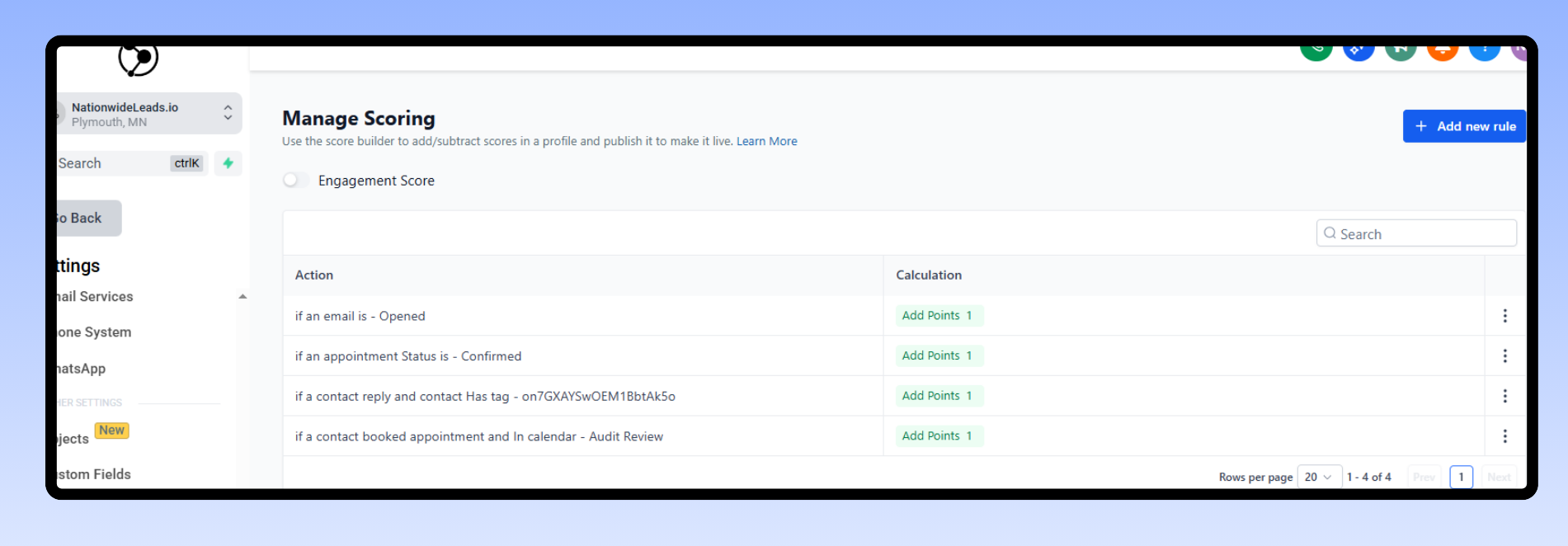
Here’s the feature you want to insist on! To optimize your sales team’s time, lead scoring aids you in targeting the appropriate individuals to concentrate on. You define rules for what counts, such as opening emails, completing forms, and visiting pages. The system does the calculations, so hot leads rise to the surface.
Automation signifies scores shift as leads do additional or less. No one has to update it manually and you always have a sense of who’s most likely to purchase.
When lead scoring is integrated with your CRM, your team can view the highest scoring leads immediately upon login. This keeps everyone on the same page, making follow-up swifter and smarter.
By observing scoring trends, you can adjust your strategies. If one action causes more sales, you can pursue those more aggressively.
CRM sync
A seamless CRM sync makes it easy to keep all your customer info in one spot. From email opens to phone calls, everything stays current no matter who on your team is working.
Syncing data means fewer typos and less double entry. That’s a time-saver and error-reducer.
Thanks to automated syncing, Pipedrive pulls in new leads and updates old ones so your database never gets outdated.
CRM data isn’t only for sales. Marketers can use it to identify who converts best to which offers and then optimize future campaigns.
Analytics
Analytics provide you the actual metrics that indicate if your marketing is effective. Dashboards track open rates, clicks, and conversions, which are all the good stuff.
There’s a lot of noise out there, so let me call out some key features to demand. You can slice and dice results by campaign, by time, or even by sales rep.
If they abandon after a specific email, you know where to improve. Armed with all this information, you’ll be able to make decisions from a place of reality, not assumption. That translates into more impact and less burnout.
The hidden costs

Marketing automation software offers the allure of efficiency and growth for small businesses. However, the true costs can extend beyond its sticker price, especially when considering hidden costs related to setting up the system and utilizing email marketing tools. These sneaky expenses can stretch budgets and stall momentum, making it crucial to train your team effectively and create high-quality content to navigate the complexities of customer interactions.
Implementation time
Transitioning to a marketing automation platform is seldom an overnight event. Small businesses need to schedule for a reasonable timeline that accounts for migrating existing data, integrating the tool with other systems, and running tests before you go live. If your business operates on legacy platforms or depends on several disparate apps, integration might necessitate additional labor or paid assistance. Utilizing effective email marketing tools can streamline this process and enhance overall efficiency.
Other times, premium onboarding or technical assistance fees could cost $50 to $150 a month just for priority help. If your team is small, you’ll end up having to commit important personnel to the transition, removing them from daily operations, which affects productivity. Keeping an eye on it is essential. Designate someone to follow milestones and identify problems early, such as data migration delays or hurdles integrating with your CRM or e-commerce system. Leveraging a robust CRM marketing automation platform can also alleviate some of these challenges by simplifying customer interactions.
When things get tricky, you may have to pay for additional assistance or more customization, particularly if your needs extend beyond the base package. All these smaller costs, fees for additional users, data storage, or advanced integrations, can accumulate, causing the overall total cost of ownership to be more than anticipated.
💡 Consider CRM solutions with free onboarding. This saves on costs and provide you the pointers you need to get to speed faster
Content creation
Here’s the catch. Content is expensive, so budget accordingly — be it blog posts, emails, social media graphics, or videos. Most small enterprises undervalue the time and resources it takes to create good, engaging content on a regular basis. You could try hiring freelance writers, designers, or agencies, but the expenses can pile up fast. Utilizing email marketing tools can help streamline your efforts and reduce costs.
Outsourcing a monthly content calendar might cost a few hundred to a few thousand dollars, depending on the level of expertise required and the scale of the effort. Other content creation tools — like graphic design apps, stock photo libraries, or video editing software — often come with their own subscriptions, which adds to the monthly bill. Investing in a crm marketing automation platform can also enhance your content strategy and optimize customer interactions.
The quality of your content will have a direct impact on campaign performance, so skimping in this area can create a bad outcome and waste your marketing budget.
Team training
A marketing automation tool is only as good as the team implementing it. The unseen expenses could translate to online trainings, vendor-led seminars, or planned internal trainings. Training costs should be a line item in your automation budget, especially if you want everyone to feel comfortable with power features or custom workflows.
Even if training is updated regularly, software updates and new features come frequently, necessitating constant learning. While it’s great to encourage staff to share tips and troubleshoot as a group, understand that the cost of keeping everyone up to date in both time and money can add up.
Absent this investment, businesses risk underutilizing their tools and leaving gains on the table.
Automation vs. outsourced digital marketing

Small businesses these days are faced with the choice to use marketing automation tools or hire outsourced digital marketers. Both have their merits, and which one is best depends on your business objectives, resources, and technical comfort.
Automation tools transformed how businesses operated, particularly once remote work became standard during the pandemic. With the proper CRM and marketing automation, the tiniest teams can wrangle leads, run campaigns, and monitor sales — all from a single platform. Automation accelerates easy tasks. For example, a standard email follow-up that once consumed hours now consumes seconds — leaving time for more strategic work.
Things such as scheduling posts, segmenting email lists, and tracking customer behavior are straightforward to implement. Tools such as HubSpot, Mailchimp, and NationwideLeads are built for non-technical users, meaning businesses can stay lean and still pack a big marketing punch.
The economics of automation are obvious. For a simple monthly fee, they receive software that automates dozens of tasks simultaneously, often supplanting the need for multiple full-time employees. This means more money remains in the business.
Automation grows with you, too. Whether sales spike or new services launch, most tools allow you to add users, campaigns, or channels with little hassle. If an ad channel is flopping, it takes a few clicks to shift budgets from Facebook to Instagram. This nimbleness enables companies to stay on top of trends and customer demands.
A solid CRM is not a nicety; it is essential for tracking sales, discovering what is effective, and delighting customers. All of this can be orchestrated and run by a small in-house staff that provides greater control and a closer sense of what the business is all about.
On the other hand, outsourced digital marketing unlocks a broader set of skills. Agencies typically have specialists in everything from strategy to content to data. This is useful if your business doesn’t own the time or expertise to construct campaigns or conduct analysis.
Agencies can introduce new thinking, install sophisticated tracking, and assist with creative work that automation cannot do on its own. Good agencies are more expensive. They might require time to familiarize themselves with the business, products, and customers—something an in-house team already knows.
It’s the trade-off between bringing on 1-2 people internally or acquiring an entire team of experts from an agency.
💡 A CRM solution with done for you digital marketing in one spot gives you the flexibility to go back and forth cost-effectively throughout your growth journey without a lengthy reset
Making your final decision
Selecting the optimal marketing automation platform for your small business isn’t a cut-and-dried exercise. It’s more than just picking the tool with the flashiest dashboard or the most features. Every business’s needs, budget, and goals are different, so what works for one team may not work for another.
Begin by assembling a list of your finalists and noting the advantages and disadvantages for each. For example, tools like HubSpot, while comprehensive and part of the hubspot marketing hub, can be expensive once you begin to scale. Others, such as Mailchimp, are easy and affordable but may lack the deep CRM integration or sophisticated workflow automation you need. Solutions such as NationwideLeads emphasize ease of use and good service, appealing to less technically savvy teams.
It assists to involve your marketing group or any staff who will use the tool in the decision-making process. Their input is crucial. What looks great on paper sometimes doesn’t match the way your team works. If you’re a solopreneur, consult with peers or online forums where actual users discuss their experience with various email marketing tools.
This feedback can reveal pain points or advantages that aren’t obvious from sales pages or demo videos. Test-driving some free trials or demo sessions allows you to see how each tool integrates with your actual workflow. Nearly all the email marketing tools provide a 14-day trial minimum, and using that time to run a sample campaign or set up a few automations helps you gauge how painless it is to get started, how responsive support is, and whether the tool aligns with your daily habits.
You may discover more about a tool’s strengths and quirks in a single afternoon of hands-on experimentation than in hours spent researching at the keyboard. Make your final call by comparing your choices to your primary business objectives and marketing requirements.
Editing: Is the tool easy enough for you or your team to use on a daily basis? Can it scale with your business? Does it work with your budget? Keep in mind that feature or option overload will give you decision fatigue, so stay true to your must-haves and resist the lure of the extras you’ll never utilize.
Trust your instincts when you get the sense a tool just clicks with your style, but do not be afraid to hold off if you’re undecided. Sometimes taking a break and coming back later with fresh eyes really clears things up.
Conclusion
Small shops and solo folks need tools that do more – not just look pretty. Marketing automation lets you work smart with less stress. Tried and true stuff counts. Easy steps, clear dashboards and help when you need it save both time and cash. Some provide you with embedded email, lead labels, and click tracking by default. Others charge you more for add-ons. You want things simple, quick and user-friendly. Best results come from real service, not a long list of features. Interested in seeing how a tool works for your team or help getting started? Drop us a note or take a demo. Real advice, real assistance, at every stage.
Frequently Asked Questions
What is marketing automation and how does it help small businesses?
Marketing automation employs powerful marketing automation software to automate repetitive marketing activities. It helps small businesses save time, engage customers, and drive sales by automating marketing campaigns.
Which marketing automation features are most important for small businesses?
Notable features include email marketing tools, lead management, analytics, and customer segmentation, which assist small businesses in executing smart marketing campaigns.
How do I choose the right marketing automation tool for my business?
Begin by defining your business requirements and budget while considering email marketing tools that are easy to use, scalable, and provide great customer support. Always try a free trial if you can!
Are there hidden costs with marketing automation tools?
Indeed, some email marketing tools may have additional fees for premium features, user licenses, or integrations with other marketing automation platforms. Always check the pricing before signing up.
Can automation replace outsourced digital marketing?
Automation might take care of the grunt work, but expert strategy or creative work from digital marketing professionals, along with effective email marketing tools, are not quite going anywhere. Many small businesses enjoy the benefits of both.
Is marketing automation only for email campaigns?
No, marketing automation platforms can handle social media, SMS marketing, lead tracking, and CRM marketing automation, providing far more than just email marketing tools.
What are the main benefits of using marketing automation for small businesses?
Marketing automation platforms save you valuable time, minimize manual errors, enhance your targeting, and increase your overall marketing results, enabling small teams to do more with less.